
什麼是觸控螢幕全貼合和半貼合?
在現代液晶顯示器產業, TFT顯示幕 with touch screen and LCD display lamination technology determines core product performance, including visual clarity, touch sensitivity, structural durability and environmental adaptability. For industrial control equipment, commercial display terminals, consumer electronics and automotive display screens, full lamination and semi lamination are the two mainstream bonding processes that dominate the market. Most buyers and engineers struggle to distinguish their structural differences, performance gaps, cost variations and application scenarios, which often leads to improper product selection and increased use costs.
觸控螢幕貼合技術基本概述
Touch screen lamination refers to the process of bonding the touch sensor panel, cover glass and LCD display module together through professional optical adhesive and precision equipment. The core purpose is to fix the structural layers of the display screen, optimize optical transmission performance, and stabilize touch signal output. The quality of the lamination process directly affects the comprehensive experience and service life of touch LCD display devices.
什麼是觸控螢幕半貼合(框貼合)?
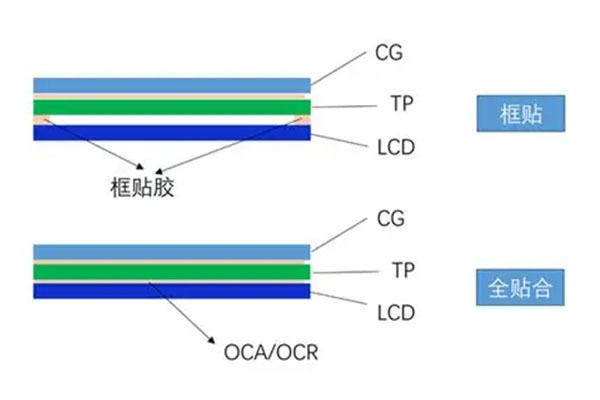
半層壓,通常稱為框架層壓或邊緣粘合,是一種傳統且經濟高效的觸控螢幕和 LCD 顯示器粘合工藝。其核心特點是僅在螢幕邊框部分粘合,而中央顯示區域在觸控面板和液晶顯示模組之間保留了自然的氣隙。
在半貼合觸控液晶螢幕的生產過程中,製造商使用高強度雙面膠帶或密封膠將觸控螢幕蓋板玻璃和感測器層的四個邊緣固定在顯示器的中框上。液晶顯示模組。黏合劑僅作用於螢幕的非顯示黑邊區域,整個可視顯示區域沒有填充任何光學黏合劑,在觸控層和液晶顯示層之間形成完整的空氣夾層。
什麼是全層壓結構?
In a fully laminated display, the optical adhesive fills every micron of space between the touch sensor and the LCD panel. The adhesive layer adds only 25 to 50 microns (0.025 to 0.05 mm) to the overall thickness. This makes the finished module approximately 0.1 mm to 0.7 mm thinner than a semi-laminated screen
全層壓中使用的黏合劑可以是:
1. OCA(光學透明膠):塗在各層之間的固體預切黏合膜。此方法速度更快,無需固化時間,且在組件上產生的熱應力最小 35 OCA 通常用於較小尺寸的顯示器。
2. OCR(光學透明樹脂):先分配液體黏合劑,然後進行紫外線固化。這種方法可以適應彎曲或不平坦的表面,通常用於較大的顯示器。
OCA和OCR均達到超過90%的透光率,保持顯示清晰度和亮度。
全貼合與半貼合:核心參數比較
為了直觀區分兩種製程的差異,以下的核心參數比較涵蓋了結構、性能、成本、維護和應用維度,涵蓋了觸控螢幕和觸控螢幕的所有關鍵評估指標。液晶顯示器選擇。
In terms of internal structure, semi lamination has border bonding + middle air gap, while full lamination has full-area seamless bonding with zero air gap. In terms of light transmittance, semi lamination is 80%-85%, and full lamination can reach more than 90%. For touch response speed, semi lamination has a slight delay, while full lamination responds instantly. In terms of dust and water resistance, semi lamination is poor and easy to enter dust and moisture, while full lamination has excellent sealing performance. In terms of production cost, semi lamination is low, and full lamination is high. In terms of maintenance difficulty, semi lamination is easy to repair with low cost, and full lamination is difficult to repair with high cost. In terms of service life, semi lamination is relatively short, and full lamination is longer and more stable.
概括
全貼合和半貼合是觸控螢幕和觸控螢幕中不可缺少的兩個核心工藝液晶顯示器產業, with their own unique advantages and applicable scenarios. Semi lamination relies on low cost and easy maintenance to occupy the mid-to-low-end display market, meeting the basic use needs of most ordinary display equipment. Full lamination relies on seamless integration, excellent optical performance, high-precision touch and strong environmental resistance to become the preferred process for high-end display equipment.