

什麼是圖形點陣STN和FSTN顯示模式?
In all monochrome display options, STN (Super Twisted Nematic) and FSTN (Film Compensated Super Twisted Nematic) display modes stand out as the most mature, reliable, and practical choices for monochrome LCD display applications worldwide. Unlike advanced TFT displays that feature redundant high-color performance and excessive power consumption for basic display scenarios, STN and FSTN graphic dot matrix screens focus on core practicality, delivering exceptional stability, low power consumption, and cost efficiency. This article comprehensively analyzes the inherent advantages of STN and FSTN display modes, clarifying their unique value in commercial and industrial display deployments, and explaining why these two technologies continue to dominate the graphic lcd display market after decades of technological iteration.
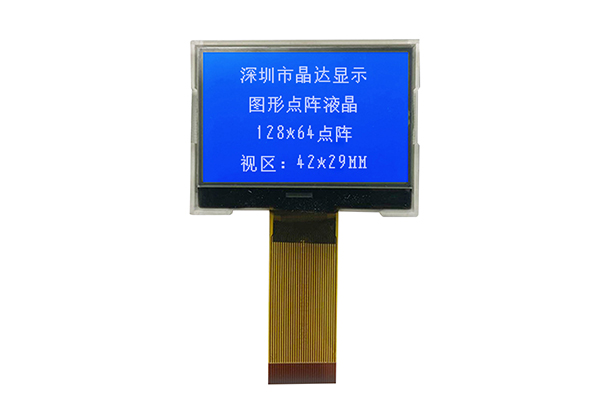
什麼是 STN 和 FSTN 技術?
Traditional TN (Twisted Nematic) LCD screens suffer from severe limitations in pixel resolution, viewing angle, and display uniformity, making them unable to support high-precision graphic lcd display output. To address these pain points, STN technology was developed with an optimized liquid crystal twist structure, increasing the liquid crystal twist angle from 90 degrees of traditional TN screens to 180–270 degrees. This structural upgrade enables STN screens to achieve accurate pixel control and continuous graphic display, laying the foundation for practical dot matrix graphic display applications.
FSTN is an upgraded iteration of STN technology, introducing a professional optical compensation film to eliminate the inherent color shift and contrast attenuation defects of traditional STN displays. As a optimized monochrome LCD display solution, FSTN inherits all the core advantages of STN while fixing its technical shortcomings, achieving ultra-high contrast, zero color deviation, and wide-viewing-angle display effects. Both STN and FSTN belong to passive matrix graphic lcd display technologies, featuring no built-in transistor pixels, simple circuit structure, and strong environmental adaptability
STN圖形點陣顯示方式的優點
作為單色液晶顯示領域的經典主流技術,STN圖形點陣屏憑藉其成熟的技術、超高的性價比、穩定的運作性能,一直保持著強勁的市場生命力。
Compared with segment code LCD screens and traditional TN dot matrix screens, STN graphic lcd display products achieve revolutionary progress in graphic presentation capability. The optimized super-twisted liquid crystal structure enables independent and accurate control of each dot matrix pixel, supporting the display of complex graphics, custom fonts, data curves, and multi-line text. For industrial instruments, smart home control panels, and portable detection devices that require real-time data and graphic overlay display, STN screens can present clear and complete graphic information without pixel distortion or blurring.
As a passive display technology, STN screens do not rely on high-power backlight drive and complex pixel circuit systems. Their working power consumption is far lower than TFT color screens and even mainstream low-power OLED screens. In actual operation, the static display power consumption of STN monochrome LCD display modules can be controlled at the milliwatt level, and the standby power consumption is almost negligible. Compared with FSTN, TFT, and other display technologies, STN screens have lower material costs, simpler processing procedures, and higher product yield. This makes STN graphic lcd display products have absolute cost advantages in mass procurement and batch production.
STN和FSTN圖形液晶顯示器的應用
STN顯示器主要應用場景
STN單色液晶顯示器憑藉著超高的性價比和穩定的基本性能,廣泛應用於對成本敏感的基礎顯示設備,包括民用智慧家居設備、普通工控儀表、傳統測量工具、電子秤、水電錶以及低端便攜式電子設備等。這些場景對顯示對比度和視覺角度要求不高,但對成本控制和長期穩定性要求較高,這恰恰契合了STN圖形液晶顯示器的核心優勢。
FSTN顯示主要應用場景
FSTN圖形液晶顯示器是針對顯示要求較高的高階工商業場景,包括汽車儀表顯示器、工業人機互動終端、醫療監控設備、精密分析儀器、戶外無人值守監控終端、商業支付終端等。這些場景要求螢幕清晰度高、視角廣、環境適應能力強、能夠長期穩定運行,而FSTN單色液晶顯示器的綜合性能完全可以滿足專業應用標準。
STN and FSTN display modes represent the most mature and practical technical solutions in the field of monochrome LCD display. STN graphic LCD display relies on ultra-high cost performance, ultra-low power consumption, and long-term stability to become the preferred choice for basic industrial and civil display scenarios. FSTN, as an upgraded version of STN technology, achieves ultra-high contrast, wide viewing angle, and zero color deviation display effects on the basis of retaining all the advantages of STN, meeting the high-standard display needs of high-end industrial, medical, automotive, and commercial scenarios.