

如何區分液晶螢幕的透射式、半透半反式、反射式?
液晶顯示器 remain one of the most dominant display technologies across consumer electronics, industrial equipment, automotive interfaces, and wearable devices worldwide. Unlike self-emissive display panels such as OLED and micro LED, LCDs do not generate light independently. According to LCD display transmission modes, we typically classify LCD displays into three types, including transmissive, transflective, and reflective. Each mode features unique optical structures, power consumption profiles, environmental adaptability, and application boundaries.
什麼是反射式液晶顯示器?
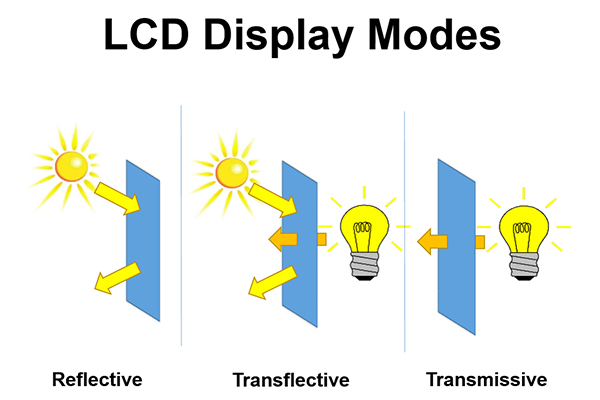
In reflection mode, ambient light is used to illuminate the display. There is no backlight source inside this kind of display. This is achieved by combining the reflector with the rear polarizer. It works best in outdoor or sunlight-readable environments. We can also find reflective display modes in graphic COG LCDs and character LCDs with positive display types. The most common devices using reflective LCDs are outdoor applications.
什麼是半透反射式液晶顯示器?
Transflective display is a hybrid of reflective and transmissive types. The transflective display combine backlight and ambient light to illuminate the pixels. They are combined with backlight and can be used for all types of lighting conditions. When there is sufficient external lighting, the backlight can be turned off to save power. In darker environments, backlight is turned on to provide a bright display. Transflective LCDs are commonly used in industrial and medical equipment.
什麼是透射式液晶顯示器?
There is a transparent rear polarizer that does not reflect ambient light. They rely on the backlight to be visible. They work best under low light conditions with continuous backlight on. For this kind of display module, light emitting from the back of the display glass must pass by the LCD towards the front to light the pixels. TFT screen usually with transmissive display module more.
對於透射式顯示器,最常見的裝置不僅使用透射式 LCD,還包括智慧型手機、平板電腦、電腦顯示器和電視。它們也用於數位相機、汽車顯示器、醫療設備等。
比較分析:透射式、半透反射式、反射式 LCD
To simplify display mode selection, we summarize the core performance differences of the three LCD modes across key dimensions. In terms of light sources, transmissive LCDs use only backlight, reflective LCDs use only ambient light, and transflective LCDs support dual light sources. For power consumption, reflective LCDs are the lowest, transflective LCDs are moderate, and transmissive LCDs are the highest.
In terms of sunlight readability, reflective and transflective modes perform excellently, while transmissive modes are poor. For low-light display performance, transmissive and transflective modes deliver high-quality images, while reflective modes are invalid. In color reproduction and resolution, transmissive LCDs rank first, followed by transflective LCDs, with reflective LCDs being the weakest. In terms of service life and stability, reflective LCDs are the best, transflective LCD displays are moderate, and transmissive LCDs are relatively limited by backlight aging.
從成本來看,反射式液晶顯示器最便宜,透射式液晶顯示器在室內場景中性價比較高,透反式液晶顯示器的單位成本最高。透過綜合比較,明確了每種模式的適用場景:選擇透射式用於室內高品質顯示,選擇反射式用於超低功耗亮環境設備,選擇透反式用於全光條件便攜式和戶外設備。
概括
透射式、反射式、半透半反式液晶顯示模式沒有絕對的優劣之分;每個都針對特定應用場景和使用者需求進行了最佳化。
1.透射式液晶顯示器主打高品質室內顯示,具有出色的色彩和解析度表現,仍是固定室內顯示設備的主流。
2.反射式液晶顯示器在超低功耗亮環境顯示方面表現出色,為簡單的長待機設備提供可靠且經濟高效的解決方案。
3.透反式液晶顯示作為混合技術的升級版,突破單模的環境限制液晶顯示器,成為便攜、跨場景戶外設備的核心顯示選擇。