

什麼是正性液晶顯示器和負性液晶顯示器?
液晶顯示器 have become the backbone of visual interfaces across countless industries—from consumer electronics and industrial instrumentation to automotive dashboards and medical devices. If you have ever shopped for industrial screens, instrument panels, automotive displays, or portable device monitors, you have likely encountered the terms positive mode LCD display and negative mode LCD display. These two core LCD display modes define the fundamental visual appearance, light transmission mechanism, readability, power consumption, and application boundaries of monochrome and basic color LCD screens. Despite their widespread use in commercial and industrial electronics, most buyers and engineers fail to fully understand their working principles, key differences, and scenario-specific advantages, leading to improper screen selection that compromises device performance and user experience.
什麼是正片液晶顯示器?
A positive LCD display is a standard LCD display mode characterized by dark text/graphics on a bright background. In an unpowered or non-activated state, the LCD pixel area remains transparent or bright, while activated pixels block light to form dark display content. Common visual manifestations include black characters on a white/grey background, black symbols on a yellow-green background, and dark icons on a reflective silver background.
正性液晶屏採用正交偏光結構,這是最傳統、應用最廣泛的液晶光學配置。此模式對環境光依賴性強,具有優異的防眩光性能,是戶外、高亮度環境顯示設備的首選。
什麼是負壓液晶顯示器?
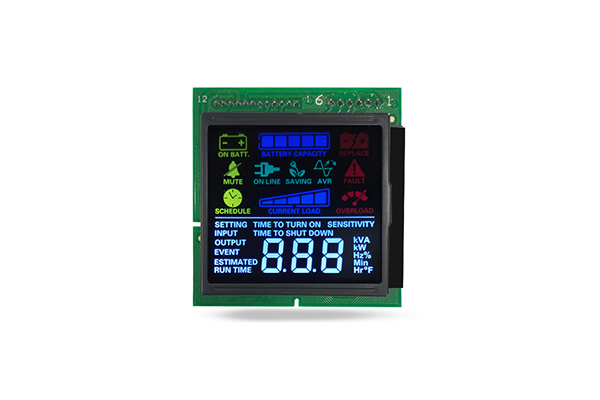
負性液晶顯示屏 is the opposite display mode, presenting bright text/graphics on a dark background. When the screen is unpowered, the entire display area is blocked and appears dark black or dark grey. When pixels are energized, liquid crystal molecules rotate to allow backlight to pass through, forming luminous bright content against the dark background.
The negative LCD displays use an aligned polarizer structure. Unlike positive LCDs, they cannot rely on ambient light for display and must be equipped with a backlight module to present clear content. This mode delivers ultra-high contrast and delicate visual effects in low-light and indoor environments, widely applied in consumer electronics, automotive interiors, and indoor industrial control panels.
正片液晶顯示器工作原理
Positive LCDs are built with two vertically crossed polarizers (90-degree offset). The liquid crystal layer in the relaxed, non-energized state rotates ambient light by 90 degrees, allowing light to smoothly pass through the two polarizers. This makes the entire screen background bright and transparent in the off state.
When a voltage is applied to a specific pixel, the liquid crystal molecules lose their twisted arrangement and align vertically with the electric field. They no longer rotate light, so incident light is blocked by the upper polarizer. The pixel area loses light transmission and forms dark text or patterns. Simply put, power-on equals dark content, power-off equals bright background.
負性液晶顯示器工作原理
Negative LCD displays adopt a parallel polarizer layout, where the upper and lower polarizers are aligned in the same direction. In the non-energized state, liquid crystal molecules twist to rotate light by 90 degrees, causing light to be blocked by the aligned polarizers. The entire screen remains dark in the off state.
When voltage is applied to target pixels, liquid crystal molecules straighten and stop rotating light. Backlight light smoothly passes through the double polarizers, forming bright, high-brightness display content on the dark background. Its core logic ispower-on equals bright content, power-off equals dark background.
正負 LCD 顯示器之間的主要區別
為了幫助您快速區分並選擇合適的顯示模式,我們從視覺效果、偏光片結構、背光依賴性、光適應性、對比度、功耗、視覺角度和成本八個關鍵維度總結了正負液晶顯示器的核心差異。
1.視覺呈現
正液晶螢幕:經典亮色背景搭配深色內容,視覺效果自然柔和,符合傳統人的閱讀習慣。螢幕色調以中性白色、灰色或黃綠色為主,長時間觀看視覺疲勞度較低。
負液晶螢幕:深色背景搭配明亮的發光內容,視覺衝擊力強,外觀高端精緻。深色背景有效突出顯示內容,使文字和圖示更加突出和層次感。
2.背光依賴性和放大器;光適應性
This is the most practical difference in application scenarios. Positive LCDs are ambient light dominant, performing best in bright environments such as outdoor sunlight, indoor strong light, and open working spaces. Even without a backlight, they can maintain ultra-clear display effects and will not be washed out by strong ambient light.
Negative LCDs are backlight dominant. They show top-tier display quality in dim indoor environments, night scenes, and low-light working conditions with uniform backlight support. However, in strong sunlight, the backlight brightness is easily overwhelmed by ambient light, leading to faded content and reduced readability. To adapt to bright environments, negative LCDs require high-brightness backlights above 800 nits, which significantly increases power consumption.
3.對比和視角表現
In indoor low-light environments, negative LCDs have far higher contrast ratios than positive LCDs. The pure dark background eliminates light leakage interference, making content edges sharper and details more delicate. Meanwhile, negative LCDs feature wider viewing angles with negligible color shift and brightness attenuation from all directions.
Positive LCDs have relatively moderate contrast. Due to the bright background, the gap between light and dark layers is smaller, but their viewing angle stability in bright environments is better. They are not prone to reflection blurring or contrast attenuation under strong light, with more stable outdoor display performance.
4.功耗及耐用性
Positive LCDs have absolute advantages in energy saving. Most application scenarios do not require backlight activation, relying entirely on ambient light for display. Even with auxiliary backlighting, low brightness is sufficient to meet demand, greatly extending device battery life. They are the first choice for low-power portable devices.
結論
正負液晶顯示器的差異是顯示器選擇中最基本的選擇之一。正向液晶顯示幕提供卓越的陽光下可讀性、更低的功耗和更低的成本,使其成為戶外、電池供電和成本敏感應用的理想選擇。負模式 LCD 顯示器可提供更高的對比度、更寬的室內視角和卓越的美感,非常適合室內、低光和注重設計的產品。