

液晶顯示器如何運作?
在現代消費性電子產業中,液晶顯示器技術經過數十年的迭代升級,仍然是最成熟、性價比最高、最廣泛應用的平板顯示解決方案之一。從工控設備、汽車儀表、家用電器到商用終端和便攜式電子設備,液晶產品涵蓋低功耗工業場景和高清商用顯示領域。
LCD is a passive light-modulating display technology based on liquid crystal photoelectric effect. The most essential feature of LCD display is that liquid crystal materials themselves cannot emit visible light. All screen images, text, and color changes are realized by adjusting the transmittance of external backlight through the ordered arrangement changes of liquid crystal molecules under electric field action. This passive light control mode determines the low power consumption, high stability, and long service life of LCD displays, and also forms the fundamental difference between LCD and self-luminous display technologies.
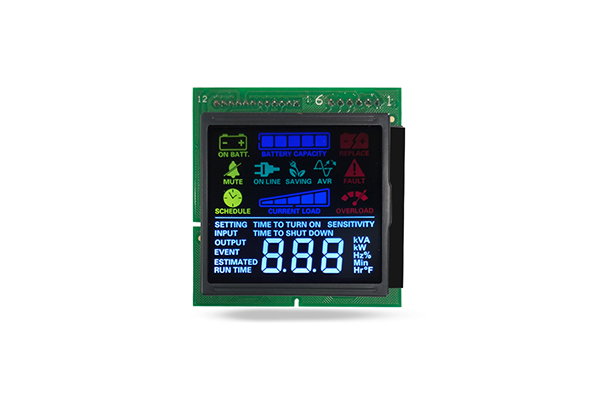
標準液晶顯示系統核心零件結構
液晶顯示器完整的工作系統由多層光學結構件和電子驅動元件組成。由下而上主要包括背光單元、下偏光片、帶有ITO電極的玻璃基板、液晶層、彩色濾光片層(僅限彩色LCD)、上偏光片和保護蓋板。
背光單元
作為一種被動顯示設備,液晶顯示器 completely depends on the backlight unit to provide stable and uniform visible light source. The backlight unit is located at the bottom of the entire display structure, mainly including light source, light guide plate, diffuser plate, reflective film, and brightness enhancement film. Early LCD products used CCFL cold cathode fluorescent lamps as light sources, while modern mainstream LCD products adopt LED backlight solutions, which have the advantages of lower power consumption, smaller volume, longer service life, and higher luminous uniformity.
偏光片組件
Polarizers are key optical components that control light transmission and are divided into lower polarizer and upper polarizer, which are respectively attached to the outer surfaces of the lower and upper glass substrates. Natural light is unpolarized light with vibration in multiple directions. The lower polarizer can filter out all irregular vibration light and only retain linearly polarized light in a single direction, providing standardized incident light for the liquid crystal layer.
預設狀態下上下偏光片的光軸設定為交叉垂直狀態,這是實現光開關控制的核心光學結構。
液晶單元層
The liquid crystal cell layer is the core functional layer of LCD display, which is formed by sealing liquid crystal materials between two layers of ultra-thin transparent glass substrates. The inner sides of the two glass substrates are plated with transparent ITO conductive electrodes and alignment films. The alignment films can limit the initial arrangement direction of liquid crystal molecules, making the liquid crystal molecules present a regular twisted arrangement in the voltage-free state. The common TN(扭曲向列)液晶結構主流液晶顯示器產品所採用的光學開關結構,可在上下基板之間形成液晶分子90度扭曲的結構,這是傳統液晶顯示器的經典光學開關結構。
驅動及控制元件
液晶分子的精確排列調整離不開專業電路的精密驅動,這也是液晶顯示器的核心電子部分。液晶模組. The driving system includes driving IC, timing control circuit, row and column scanning circuit, and signal processing circuit. Each pixel unit of the LCD panel corresponds to an independent control circuit. Through row and column scanning, the system inputs different voltage signals to each pixel in real time, realizing independent brightness control of each pixel.
LCD顯示器完整的工作機制
LCD顯示器的工作過程 is a continuous cycle of light generation, polarization, electric field modulation, light transmission screening, and image restoration. The whole process is completely based on physical photoelectric changes, with no chemical reaction, so the display process has high stability and repeatability. The following is a step-by-step in-depth analysis of the working principle of LCD display in combination with optical and electrical characteristics.
光源輸出和偏振處理
First, the LED light source of the backlight unit emits uniform scattered visible light. After being homogenized and reflected by the light guide plate and diffuser plate, stable surface light source is formed and acts on the lower polarizer. The lower polarizer filters the unpolarized natural light and converts it into unidirectional linearly polarized light. At this time, the light has a single vibration direction, laying a foundation for the subsequent liquid crystal modulation.
無電壓狀態:光傳輸和亮像素形成
When no driving voltage is applied to the ITO electrode of a certain pixel unit, the liquid crystal molecules in the liquid crystal cell maintain the initial 90-degree twisted arrangement under the restriction of the alignment film. When the linearly polarized light passes through the twisted liquid crystal layer, the polarization direction of the light will be rotated 90 degrees synchronously with the molecular arrangement. After rotation, the polarization direction of the light is completely consistent with the optical axis of the upper polarizer, so the light can smoothly penetrate the upper polarizer and the protective cover plate, and finally present a bright state on the screen.
施加電壓狀態:光阻擋和暗像素形成
When the system inputs a specific driving voltage to the pixel electrode, an electric field is formed between the upper and lower glass substrates. Driven by the electric field force, the twisted liquid crystal molecules will gradually deflect and arrange vertically along the electric field direction. At this time, the twisted structure of the liquid crystal layer disappears, and the liquid crystal molecules lose the ability to rotate the polarization direction of light. The linearly polarized light passing through the liquid crystal layer keeps the original vibration direction, which is completely perpendicular to the optical axis of the upper polarizer. The light is completely blocked and cannot penetrate, and the pixel presents a pure black state.
上一个:如何區分LCD和LED?